
The Inheritors
How Mbappé, Haaland, and Bellingham brought basketball's empire model to football

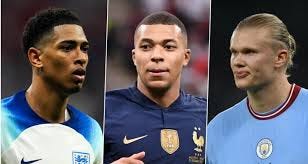
The old model produced football champions from chaos.
Ronaldo Nazario grew up in Bento Ribeiro, a poor suburb of Rio de Janeiro. He nearly missed his trial at Cruzeiro because his family could not afford the bus fare. David Beckham, a working-class boy from East London, rose purely through on-pitch performance at a time when the idea of a footballer as a corporate blueprint did not exist. Zinedine Zidane was raised in La Castellane, a housing project in the northern suburbs of Marseille notorious for overcrowding, crime, and unemployment. His parents, Algerian Kabyle immigrants, lived in a flat so small that all seven family members could not sit down to eat at the same time. He learned football on concrete. Cristiano Ronaldo grew up on the island of Madeira, the son of a cleaner and a kit man. Lionel Messi grew up in Rosario, Argentina, receiving growth-hormone injections paid for by Barcelona from the age of thirteen. These are the founding stories of football’s modern era, businesses evolving around one person. Poverty, disruption, relocation, then talent discovered almost by accident. The architecture came after the player.
Two of those players, Cristiano Ronaldo and Messi, went on to change football in ways that had nothing to do with what happened on the pitch. They made the footballer a global celebrity product. Between them, over a billion social media followers. Ronaldo built CR7 into a fragrance line, a hotel chain, an underwear brand, a museum, and a billionaire. Messi took an equity stake in Inter Miami and partnered with Apple TV to produce a documentary about himself. They turned football into a sport where the best players were also, separately, media properties. But they did not plan it. They were footballers who became brands. The commercial architecture was a byproduct of their playing careers, not a blueprint. They opened a door. They did not design the building on the other side. These days you find it normal when you watch a player’s story on Netflix or Amazon Prime, but back in 2014 and 2015, athlete-driven feature documentaries were an extreme rarity, reserved only for the absolute apex of the sport: Messi and Ronaldo were the only two footballers on the planet who could justify a cinema release about their lives.
On the other hand, top Gen Z players of our day: Kylian Mbappé, Erling Haaland, and Jude Bellingham walked through that door and started building. They are not footballers who became brands. They are brands who became footballers. Three families operating as career management firms. Three corporate entities registered before any of them had played a top-flight minute. Three coordinated plans, beginning at age six and running through to club ownership at twenty-five in one case. The football is not the product. The football is the platform on which the product runs.
What they are constructing is not football’s traditional model. It is similar to basketball’s. Michael Jordan turned a shoe deal he made before his career took off into a billion-dollar brand empire. Magic Johnson became a media and real-estate mogul who now owns a share of the Los Angeles Dodgers. LeBron James built SpringHill Entertainment into a production company that made a Hollywood film, launched Uninterrupted as a media platform, and took a stake in Liverpool FC in 2011, long before the idea of an athlete owning a football club was taken seriously. These are only some investments in his wider portfolio. For nearly three decades, the NBA produced athlete-entrepreneurs who controlled their own narratives, owned their own companies, and treated the sport as a launch platform for something larger. Football recently started the same pattern. Even Beckham’s business take-off can be considered recent.
The Inheritors are the first generation of footballers who operate the way top-tier NBA players have operated for decades: the career is the asset, the brand is the business, and the sport is the beginning, not the end. What follows is the case for each. Today we don’t have a story but an unveiling of a pattern, in our own words.
Jude Bellingham
Bellingham was born in 2003 in Stourbridge, in the Black Country, the industrial West Midlands. His father Mark scored more than 700 non-league goals as a striker at Stourbridge, Hednesford Town, and Paget Rangers while working full-time as a sergeant in the West Midlands police. His mother Denise managed both her sons’ lives. His younger brother Jobe now plays for Sunderland. English football has a tradition of working-class authenticity: the council-estate boy, the apprentice scrubbing the boots of the senior pros. The Bellinghams fit that template in the roots. In the strategy, they were the opposite. They incorporated. They picked a foreign league. They retained image-rights companies before Jude had played a Premier League minute. The accent stayed Stourbridge. The strategy was more American than English.
By sixteen years and thirty-eight days, Jude was Birmingham City’s youngest-ever player, breaking a record held by Trevor Francis since 1970. In 2020, every major English club wanted him. Manchester United pulled out the heaviest pitch in their modern history: Sir Alex Ferguson, Eric Cantona, and Bryan Robson all met the family at Carrington. City watched. Liverpool inquired. Chelsea sent representatives. The family chose Borussia Dortmund. The number of English seventeen-year-olds who have left the Premier League pipeline for a foreign league in the past forty years can essentially be counted on one hand: Owen Hargreaves to Bayern in 2000, Jadon Sancho to Dortmund in 2017, then Bellingham in 2020. English football’s gravitational pull is the strongest in the game. Bellingham left anyway, because Sancho had proven the path worked, because Dortmund guaranteed first-team minutes that United could not, and because the contract created a controlled three-year window before the next move. Birmingham retired his number 22 shirt, a first in the club’s history, before he had played a Premier League minute. He was seventeen, just as LeBron James was when St. Vincent-St. Mary High School retired his jersey before his NBA career had begun.
14 April 2021. Champions League quarter-final, Dortmund against Manchester City. Bellingham scored at seventeen years and 289 days, the youngest English player ever to score in the Champions League. By nineteen he was the Bundesliga’s youngest-ever captain. By twenty, Bundesliga Player of the Season, Kopa Trophy winner. Three seasons. 132 appearances. Then the family architecture activated the next move.
Real Madrid. €103 million rising to €133 million. He took the number 5 shirt, made iconic by Zidane between 2001 and 2006, as a deliberate homage. His father Mark had worn a Zidane 5 shirt around the house for years. Fourteen goals in his first fifteen matches. A Champions League title in his first season. An assist for Vinícius Júnior’s winner in the final against his former club Dortmund. Third in the Ballon d’Or at twenty. The Dortmund years were not a delay. They were the runway.
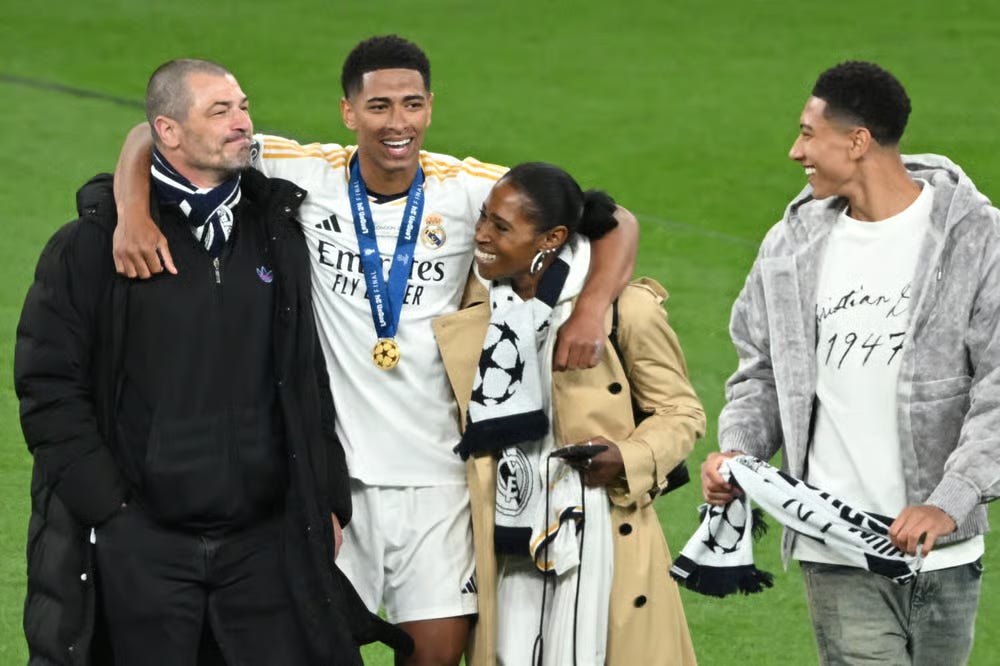
‘’Wembley, June 2024: The Bellingham clan celebrates Real Madrid’s 15th European crown. A family triumph disguised as a football match’’
Bello & Bello Ltd was registered in 2019, when Jude was sixteen, before he had played a Bundesliga minute. A second company, Belloball, followed. A third entity, Jude Bellingham Limited, was registered in November 2024, probably prepared for future ventures. Three separate, structured entities operationalising one global brand before the player turned twenty-two. The Adidas “JB Line” launched in 2024. Louis Vuitton “Friend of the House.” Skims face and body. Lucozade “Ice Kick,” co-designed by Jude, 150 million engagements at launch. The Beatles’ “Hey Jude” soundtracking the Adidas Euro 2024 campaign, sung by Paul McCartney, co-starring Beckham and Lampard, was a deliberate cultural inheritance sequence approved by all three estates. Music history, football history, brand history, collapsed into one sixty-second advert. His Instagram bio routes inquiries to enquiries@belloandbello.com. The old generation hired agents. This one publishes the inbox.
‘’Adidas: Hey Jude (2024)’’
Mark structures the multi-million-euro deals and handles the complex financial and legal architecture as a registered FA intermediary, described by one senior football figure as “a fierce negotiator and a really shrewd operator.” Denise coordinates the day-to-day back-office operations and lifestyle from Madrid. The family did not relocate when Jude moved. The family operationalised.
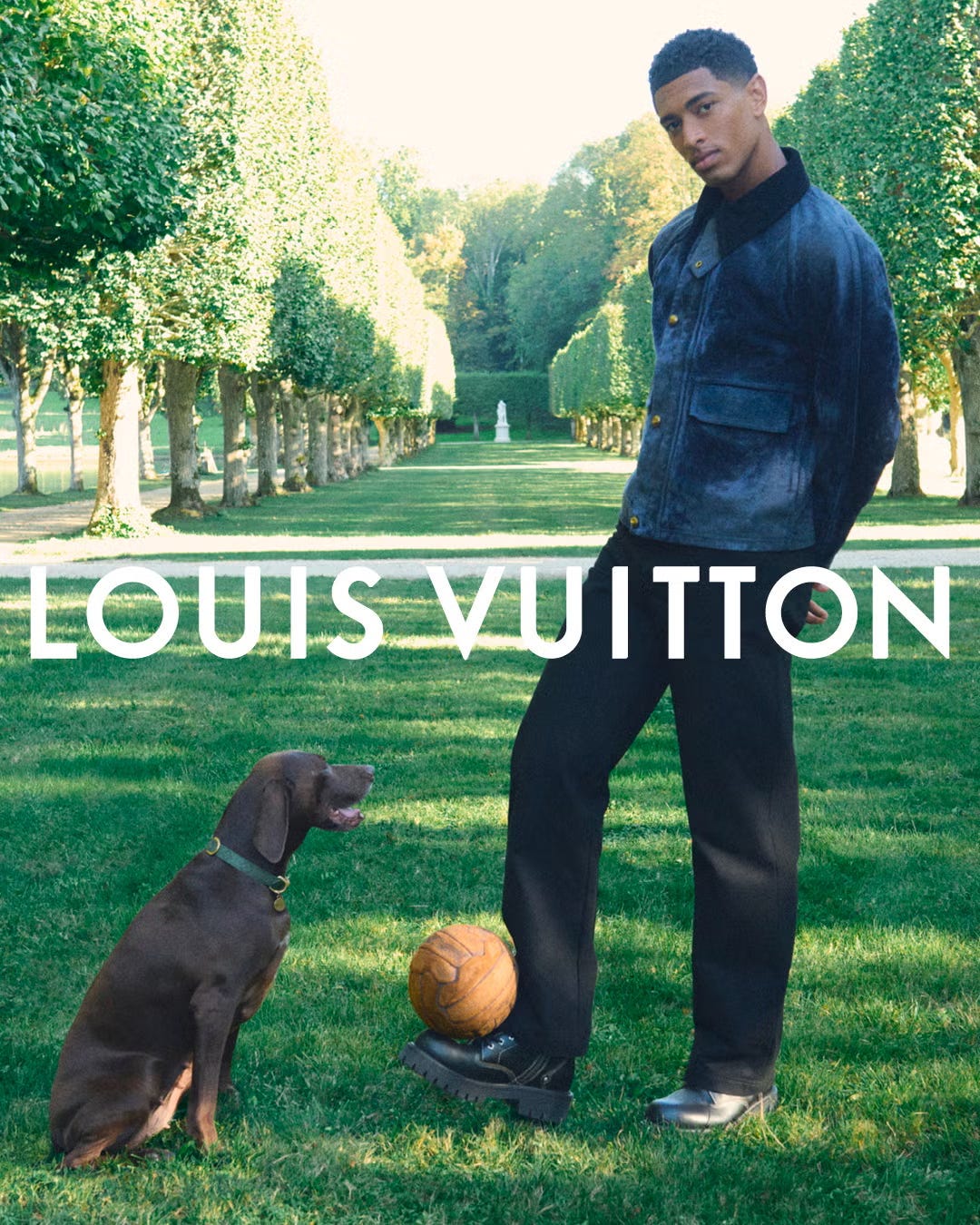
‘’Bellingham’s LV Banner’’
Erling Haaland
Haaland was born in 2000 in Leeds, because his father Alf-Inge was playing for Leeds United in the Premier League. The football pedigree runs deeper than the father alone. His mother Gry Marita Braut was a national-level Norwegian heptathlete. His cousins Jonatan Braut Brunes, Emma Braut Brunes, and Albert Braut Tjåland are all professional footballers. Tjåland plays at Molde, the same club and the same Solskjær pipeline that produced Erling. His great-uncle and great-uncle’s son were both professional players. His partner Isabel Haugseng Johansen, with whom he had a son in December 2024, played for Bryne FK’s women’s senior team. They met at the same youth academy as children. Erling Haaland is not the son of a footballer. He is the son of a footballing clan, and the partner of another footballer from the same town.
After Roy Keane’s revenge tackle ended Alf-Inge’s career at Manchester City in 2001, the family returned to Bryne, a Norwegian town of twelve thousand deeply shaped by Janteloven, the unwritten Scandinavian code that says you must not think yourself better than others. Haaland’s flat, monotone interviews read in Manchester as corporate humility. In Bryne, they read as cultural compliance. This matters: his entire brand, the documentary, the YouTube channel, the cryotherapy chamber, the bovine heart and liver, is packaged inside a voiceover that insists none of it is marketing. The marketing works because the marketing denies it is marketing.
At sixteen, his father sent him to Molde to play under Ole Gunnar Solskjær, a Norwegian striker who would understand a Norwegian striker. When Solskjær became Manchester United manager and called personally in 2019, the family said no. They chose Red Bull Salzburg: guaranteed Champions League minutes, the Red Bull progression network, a buy-out clause for eighteen months later. The family bought him a runway, not a destination.
The night before his Champions League debut, in September 2019, Haaland was driving alone through Salzburg listening to the Champions League anthem at full volume. A car pulled up next to the Salzburg captain Andreas Ulmer, who was walking with his daughter. Window down. Inside was the nineteen-year-old, alone, grinning, the anthem blaring. His teammate Max Wober told the press: “Erling is crazy.” Haaland later confirmed the ritual: he had been listening to the anthem since he was a child. At Dortmund, he set it as his phone alarm. He kept it at City. A childhood obsession turned into a daily liturgy, turned into a shareable brand asset.

‘’The night before first Champions League Night’’
The next night, against Genk, he scored a first-half hat-trick on Champions League debut, the only player in the competition’s history to do so. He then scored in his next four Champions League matches: eight goals in five games, the fastest start anyone had made.
Dortmund triggered his buy-out for €20 million in January 2020. Two and a half years at Dortmund: 86 goals in 89 appearances. Then Manchester City. First season: 36 Premier League goals, a competition record, 52 in all competitions, a continental treble. The transfer announcement video opened with a photograph of three-year-old Erling on a sofa in a 2002-03 Manchester City kit. It cut to twenty-two-year-old Erling in the 2022-23 home shirt, holding that same photo. The childhood was the marketing. The marketing was the childhood.
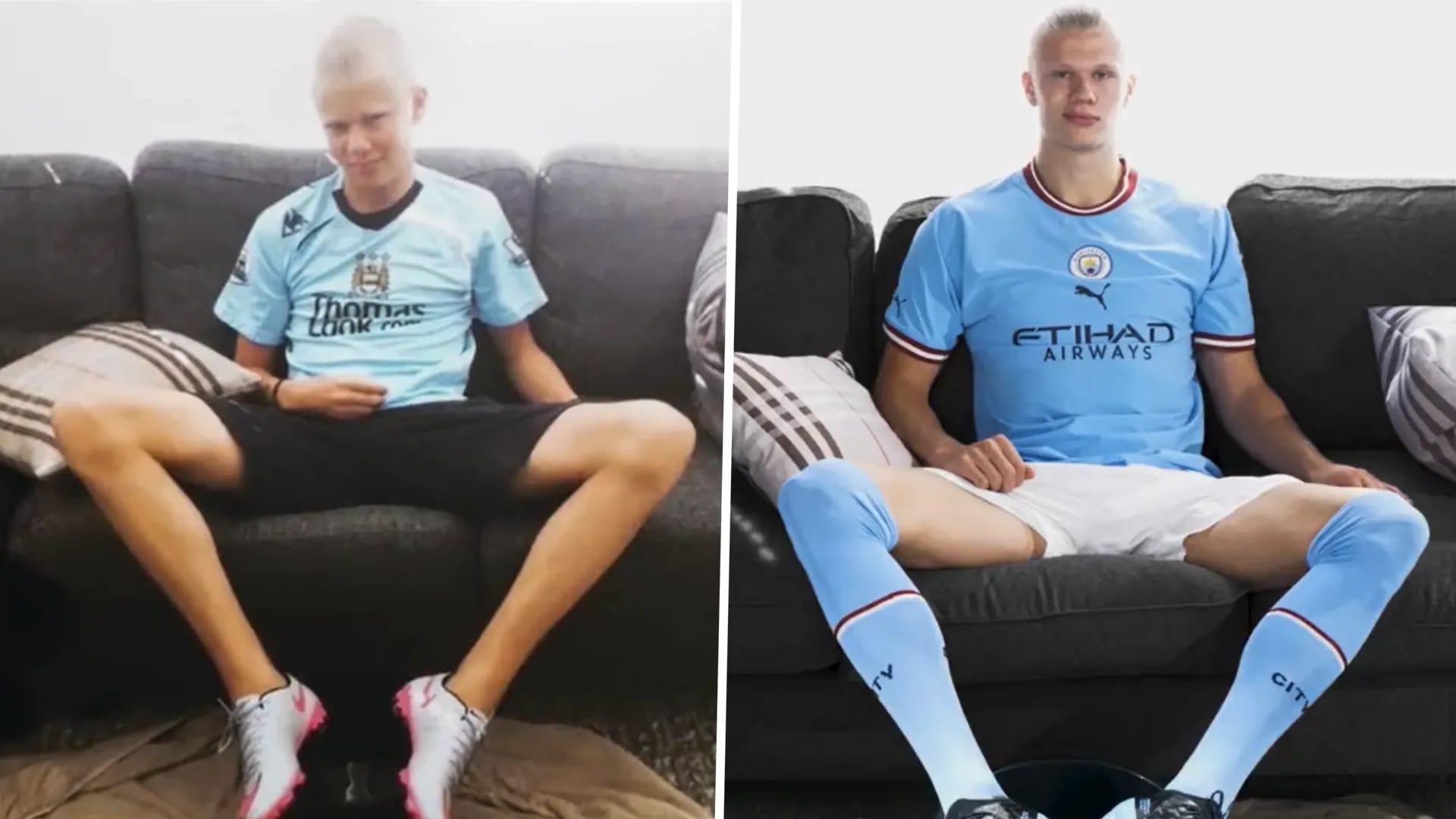
‘’The childhood was the marketing. Haaland’s City unveiling seamlessly blending past lineage with present dominance.’’
The empire layer is quieter than Mbappé’s or Bellingham’s, but it exists. Dolce & Gabbana brand ambassador since 2023. A £50,000 cryotherapy chamber in his Chester mansion. “Haaland: The Big Decision,” his own documentary, released the week of his Champions League debut for City. A YouTube channel launched in 2025 narrating his daily routine in flat Scandinavian monotone: bovine heart, ice baths, lights out at ten. Even at fifteen, he and two Norway U17 teammates had released a rap single called “Kygo Jo” under the name Flow Kingz. The video went viral only after Haaland achieved global fame, accumulating over fourteen million YouTube views as fans dug up the digital breadcrumb, but the point is that the breadcrumb existed. He had planted a media presence before he had played a senior professional match. In January 2025, he signed a contract with Manchester City through 2034, the longest in the club’s history, worth a reported £500,000 per week. According to the 2026 Sunday Times Tax List, Haaland paid £16.9 million in tax over the past year, the highest of any footballer in the United Kingdom and enough to place him 72nd among the country’s biggest taxpayers. He is also the youngest person on the entire list. A twenty-five-year-old Norwegian, born in Leeds, raised in a fishing town of twelve thousand, now among the hundred highest individual contributors to the British treasury. Of the three, Haaland is the purest footballer. He is also the proof that even the purest footballer is no longer just a footballer.
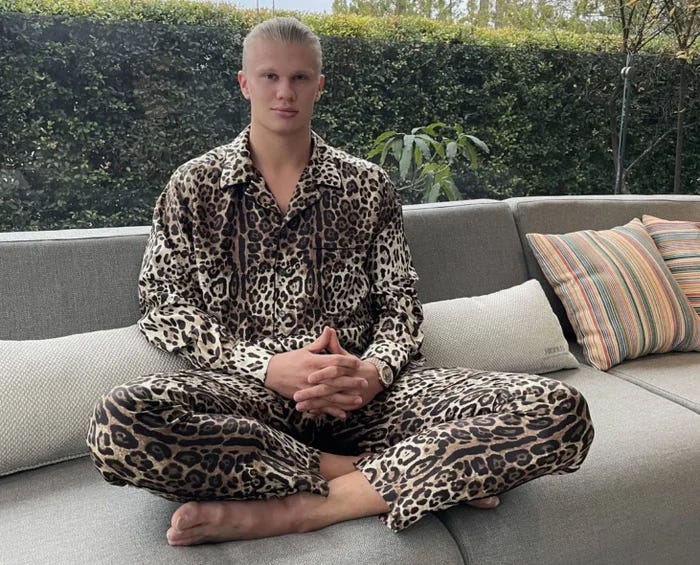
‘’Haaland in Silk D&G Pijamas’’
Kylian Mbappé
Mbappé was born in 1998 in Bondy, a banlieue town in Seine-Saint-Denis, the poorest department in mainland France and a postcode that produces more professional footballers per capita than anywhere else in Europe. But the Mbappé household was not the standard banlieue story. His father Wilfried, of Cameroonian origin, was the head youth coach at AS Bondy. His mother Fayza Lamari, of Algerian origin, played handball at first-tier French level. His adopted older brother Jirès Kembo Ekoko became a professional footballer at Rennes. His younger brother Ethan now plays at Lille. The professional environment was the home environment. Football was not aspirational. It was operational. They are like a family where each member is an Ivy League legacy.
By eleven, Real Madrid had invited him to train with their academy. Zidane hosted him personally. The family said no. They said no again at fourteen, when Chelsea flew him to London. Again at sixteen, when Madrid bid for his Monaco contract. Six rejections of Real Madrid across thirteen years. He finally joined in 2024, at twenty-five, on his terms. No top-tier transfer target in modern football has been pursued by one club for so long, and resisted for so long.
He went to Monaco at fourteen because the academy had a first-team pathway and the contract guaranteed senior minutes within three years. The architecture worked. At sixteen years and 347 days, he broke Thierry Henry’s record as Monaco’s youngest first-team player. The 2016-17 season made him: 26 goals in 44 matches, a Ligue 1 title, and a Champions League run that included six knockout-stage goals. He scored in both legs against Pep Guardiola’s Manchester City. He scored in both legs against Dortmund. By eighteen, he had reached the Champions League semi-final. No teenager in the competition’s history had scored more in a single campaign. In the 2018 World Cup final, he became the first teenager to score since Pelé in 1958, which itself became a self-replicating content unit: posters, magazine covers, brand campaigns, Pelé’s personal congratulations.
PSG signed him in August 2017 for €180 million, the most expensive teenager in history. Seven years at PSG produced six Ligue 1 titles, 256 goals, the 2020 Champions League final. Then he left, on a free transfer, at the moment the family decided Madrid had waited long enough.
‘’Madrid, July 2024: 80,000 fans welcome Kylian Mbappé—a global brand patron arriving entirely on his own terms.’’
By then the empire was already under construction. In 2022, at twenty-three, he founded Zebra Valley, a Los Angeles production company represented by WME Sports, the agency that handles Hollywood A-listers. Within months: a multi-year NBA content partnership, a first-look deal with Skydance Sports, creative work for Loewe. The structural model is LeBron James’s SpringHill, a full-scale entertainment development and Hollywood production powerhouse that has produced feature films, television series, and documentaries, not David Beckham’s image-rights agreements. He is not a brand face. He is a brand patron. Two weeks after his Bernabéu unveiling in July 2024, he bought 80% of SM Caen through Coalition Capital for €15-20 million, becoming the youngest active footballer to own a European professional club. For comparison, it took Ronaldo Nazario twenty-five years from his professional debut to acquire Real Valladolid in 2018, and twenty-eight years to buy his boyhood club Cruzeiro in 2021. Mbappé bought Caen nine years into his career. The closing detail does the work: in 2012, Caen had wanted to sign thirteen-year-old Mbappé and could not afford to. In 2024, Kylian Mbappé bought the club that couldn’t afford him as a child.
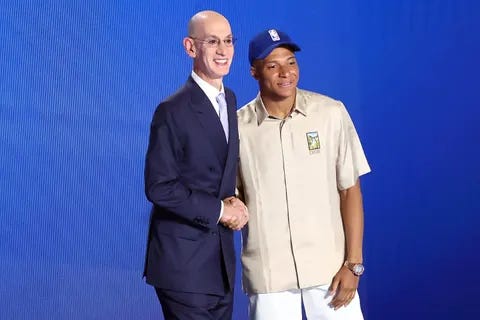
‘’Zebra Valley partners up with NBA’’
The Pattern
The three rejected, between them, Real Madrid six times, Manchester United twice, Manchester City once, Liverpool, Chelsea, Tottenham, Juventus, and Bayern. They chose Monaco, Salzburg, and Dortmund. The pattern is not anti-glamour. It is anti-mismatch: the club where development compounds value fastest, then the move timed to maximum valuation. Monaco gave Mbappé Champions League knockout minutes at seventeen. Salzburg and Dortmund gave Haaland Champions League goals at nineteen. Dortmund gave Bellingham a captaincy at nineteen. In each case, the bigger club would have offered less playing time and a delayed brand emergence.
The Champions League is the global brand vehicle. The Premier League, La Liga, Bundesliga, and Ligue 1 are domestic monetisation. All three scored Champions League goals as teenagers because of where they signed. By comparison, Ronaldo, the competition’s all-time highest goal scorer, did not score in the Champions League until his twenty-sixth outing. The Inheritors compressed the Champions League emergence by two to four years. That is not luck. That is club selection plus contract structuring.
Ronaldo and Messi opened the door. They made football’s stars globally bankable for the first time. But they backed into it. Beckham became a brand after his career. Ronaldo became a brand alongside his career. Messi became a brand at the end of his career. Mbappé, Haaland, and Bellingham became brands before their careers. The football came along to validate what the family had already built. They did not walk through an open door. They designed the building on the other side.
The honest counter is that the system is not required. It is accelerative. Lamine Yamal comes from a household with no football pedigree and will likely win a Ballon d’Or before twenty. Bukayo Saka captains Arsenal without an inherited architecture. Vinícius Júnior came up through Rio de Janeiro’s favela leagues and Flamengo’s academy. The Inheritor model produces a higher rate of structured stars; it does not produce all of the stars. The football meritocracy is not dead. But the top tier is becoming hereditable, and the children who arrive with the architecture pre-built arrive faster, monetise sooner, and last longer.
This is not a story about three great footballers. If it were, it would be about their goals, their trophies, their Ballon d’Or finishes. This is a story about what happens around the football, and increasingly instead of it. Empire building, happening in real time, while the matches are still being played. Mbappé owns a club. Haaland’s body and Norwegian lifestyle is a content stream. Bellingham’s family reads contracts in a Madrid villa. These are not post-career activities. They are the career.
The forward look writes itself. Jobe Bellingham at Sunderland, the second-generation test case inside one family. Endrick at Real Madrid, a Brazilian inheritor at the same club where Mbappé and Bellingham operate. Albert Tjåland at Molde, Haaland’s cousin, same pipeline.
For three decades, the NBA had Jordan, Magic, and LeBron building empires from inside the sport. Football watched from across the Atlantic and assumed it was a basketball thing. It was not a basketball thing. It was a scale thing. And the scale has arrived. The football is real. But the football is also the marketing. The career is real. But the career is also the beginning. The Inheritors are the proof-of-concept. What follows is the rollout.